
Skip to content
Lithurin

Ground and polished concrete

Polished concrete is a choice of system, not just of grinding

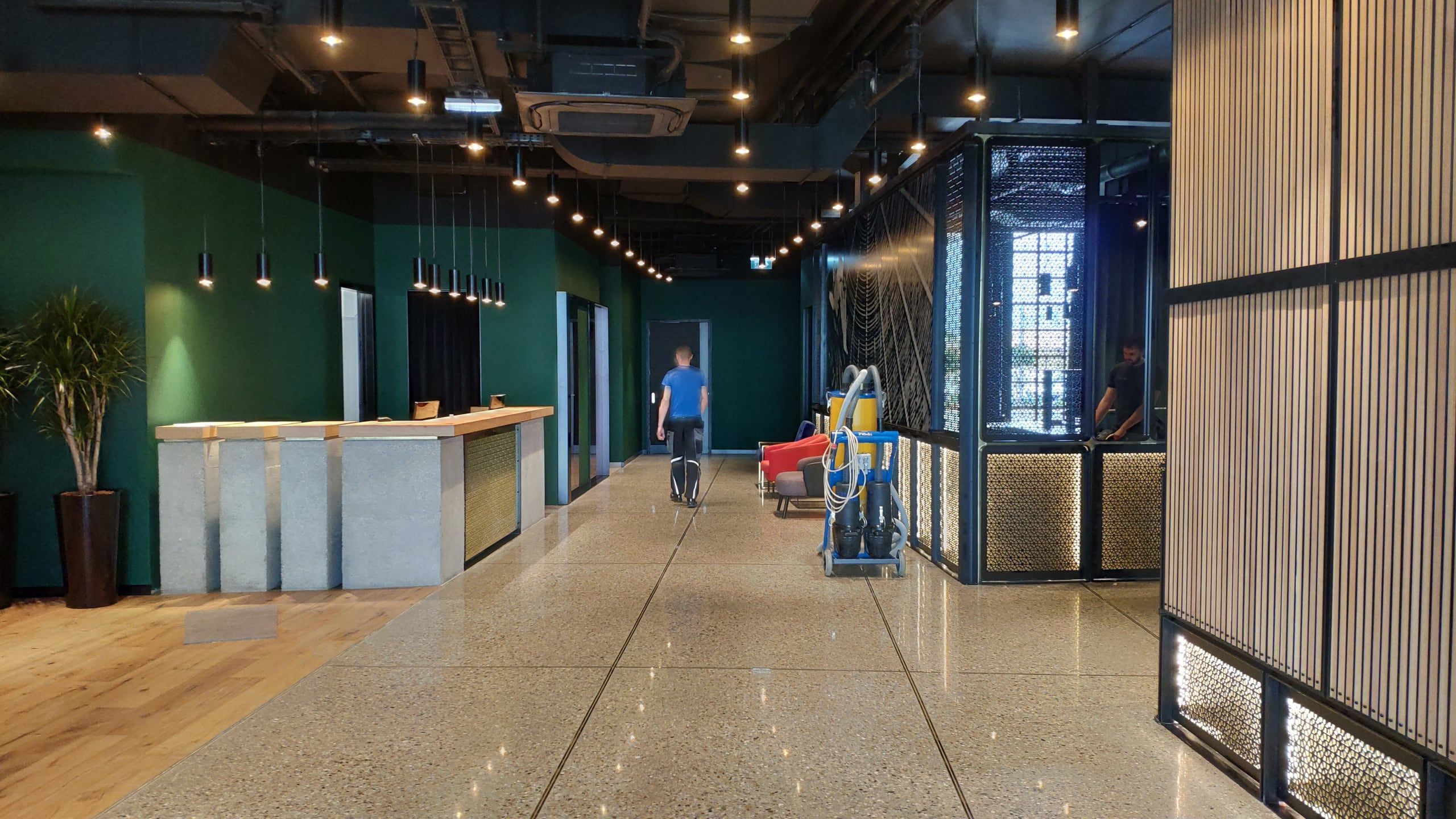
Ground concrete floor in a hotel lobby

With ground and polished concrete, the result depends as much on the substrate as on the grinding process. HARD before grinding creates a harder substrate, SEAL 3.0 closes the pores before polishing, and PROTEC adds stain protection. We include DENS when the project calls for a separate densifying step.

Who it is for

Architects, main contractors, industrial flooring contractors

What the floor has to cope with

  • A soft top layer before grinding
  • Open pores and uneven gloss
  • Stains after polishing

What we aim to achieve

  • A harder substrate that helps gloss develop earlier
  • Pores closed before polishing
  • Stain protection in the finished surface

Polished concrete starts below the surface

How ground concrete looks depends on what lies beneath the surface. See how HARD hardens the surface layer before grinding, how ever finer diamonds expose the aggregate and smooth the surface, and how SEAL 3.0 closes the pores and PROTEC improves stain protection.

Skip to the recommended sequence

Illustration, not a measurement.

A soft top layer dusts and absorbs

The top layer of a new or existing slab is often softer than the concrete below it. Under wheels it breaks down into dust, and spills soak into the open pores. Grinding a surface like this on its own gives a weak base for a good finish.

  • Concrete dusting

    The soft top layer breaks down under wheels into fine dust that keeps coming back after cleaning.

  • Liquid absorption

    Spilled coffee, water or oil soaks into the open pores and leaves a stain.

Illustration: A block of concrete slab with a pale, soft top layer and power-float marks. Dust rises behind the wheels of a trolley, and a spilled liquid soaks into the concrete, visible in the section.

HARD hardens the surface layer before grinding

We apply HARD before grinding starts. It penetrates the surface layer and reacts there with the free lime in the concrete, making the layer harder and denser. Because the diamonds then grind a firmer base, the shine can develop sooner.

Illustration: The surface layer of the block is marked in violet, with an unnumbered dimension line beside it: this is where HARD has reacted in the concrete. The top layer is not yet ground.

Ever finer diamonds, then SEAL 3.0

We grind in several passes, from coarse to fine diamonds. The first passes remove the soft top layer and expose the aggregate; the following ones smooth out the scratches. Before polishing we apply SEAL 3.0, which closes the pores in the surface.

Grit numbers are for illustration. We set the number and order of passes to suit the slab.

Illustration: A ground surface with exposed aggregate and fine scratches. The first faint reflections of the windows appear in the surface, and the pores are closed after SEAL 3.0 is applied.

Polishing, then PROTEC

As we polish, light and windows begin to reflect in the surface. Finally we add PROTEC, which improves stain protection: drops stay on the surface and are easier to wipe up.

We do not promise a particular level of gloss. The final look depends on the quality of the slab, how much aggregate is exposed, the grinding process and maintenance.

Illustration: A polished surface with exposed aggregate and the reflection of two windows. After PROTEC is applied, a drop of water stays on the surface as a bead.

Recommended sequence

A starting point for a site visit. We set the final sequence according to the condition of the concrete, the preparation and how the floor is cleaned.

Our projects in this sector

  • Hotel Zagreb: Ground concrete in public areas

    Hotel Zagreb

    Hospitality

All projects

References listed by the manufacturer, AB Lindec

International references of the manufacturer, not projects carried out by the contractor in Slovenia or Croatia.

  • Northvolt
  • Facebook

Frequently asked questions

Does the system guarantee a specific gloss level?

No. Gloss depends on the quality of the concrete, the degree of aggregate exposure, the grinding process and maintenance. The system helps gloss develop, but does not guarantee it.

Show us your floor. We will recommend the right sequence.

On a site visit we check the condition of the concrete, the traffic, how the floor is cleaned and what it is exposed to. Then we propose the surface preparation, the product sequence and a schedule that fits around your operations.

Book a site visitShow phone number

Opening hours: Mon–Fri 8:00–16:00