
Skip to content
Lithurin

Impregnation that becomes part of the concrete

Lithurin Formula is a system of water-based impregnating agents from the Swedish manufacturer AB Lindec. Rather than building a layer on top of the concrete, it improves the surface layer of the concrete itself.

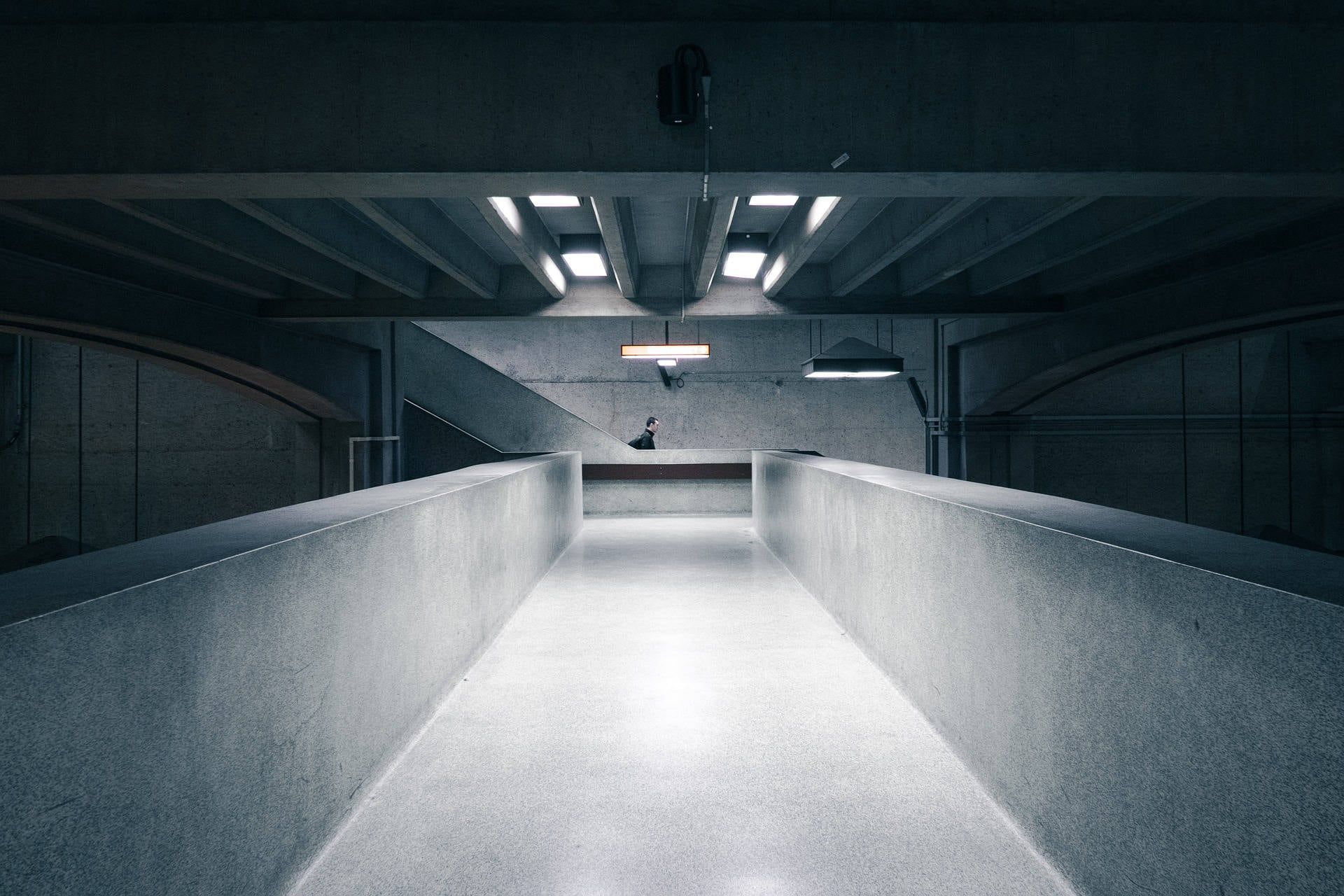
Concrete corridor with a smooth treated floor and walls

What happens inside the concrete

The impregnating agent penetrates the surface layer and reacts with compounds in the cement paste. The pores fill and the layer becomes harder and denser. Once the reaction is complete, there is no separate layer left that could come away.

Skip to the comparison with coatings

Illustration, not a measurement.

How deep it goes

Lithurin HARD is a water-based impregnating agent. We apply it with a low-pressure sprayer, and it then penetrates the surface layer of the concrete through its capillaries and pores. It reacts there, so it does not stay on top as a film.

Penetration depth depends on the porosity of the concrete and on preparation, so we do not give it as a figure. A ground surface with open pores absorbs more than a dense, power-floated skin. That is why we grind existing floors first.

Illustration: Cross-section of two concrete samples. On the left, a ground surface with open pores; on the right, a dense power-floated skin. A violet impregnation front moves down the capillaries, deeper into the ground sample than into the floated one. Dimension lines without figures mark the treated surface layer. A circle marks a single pore.

Lime turns into C-S-H

The pores of the cement paste contain free lime (calcium hydroxide). The fluorosilicate in HARD reacts with it to form calcium silicate hydrate (C-S-H) and calcium fluoride, which fill the micropores and harden the surface layer.

reaction in the poreCa(OH)2 + fluorosilicate → C-S-H + CaF2

DENS reacts in the surface layer and makes it denser and more uniform. It is suitable for prepared existing floors and levelling compounds, and as an intermediate step.

Illustration: Close-up of a single pore. Hexagonal plates of calcium hydroxide sit on the pore wall. Fluorosilicate flows in through a capillary, fibrous C-S-H crystals grow from the walls, and fine CaF2 particles lie between them. The empty space in the pore is much smaller.

A coating can peel; impregnation stays in the concrete

An epoxy or acrylic coating is a film on top of the concrete. Under wheels and at joints the film can crack, water then gets underneath and the coating starts to lift. To renew it, the old coating has to be removed and a new one applied. Impregnation reacts within the surface layer, so there is no film to come unstuck.

Treated concrete still needs cleaning, and under traffic it wears over time. The difference is that it has no film to lose.

Peeling coating

Illustration: Cross-section of two slabs that a forklift wheel has crossed three times. On the left, the coating has cracked over a joint, water has got under the film, and the film has lifted and curled. On the right, the wheel stands on the treated slab: the treated layer, marked in violet, is part of the concrete and there is no film.

SEAL or SEAL 3.0

Both products seal the concrete surface and reduce dusting and liquid absorption, but they do different jobs. SEAL is for dry indoor areas. SEAL 3.0 also suits outdoor and wet surfaces, mortars and levelling compounds, and ground concrete before polishing.

Your floor

Choose what applies to your floor.

Where is the floor?
Wet cleaning or water on the floor?
Substrate
Polishing

Answer the questions and we will show you the right product.

SEAL

Dry indoor concrete floor, not polished: SEAL binds dust and makes cleaning easier. SEAL 3.0 is also suitable.

Lithurin SEALLithurin SEAL 3.0

SEAL 3.0

  • SEAL is for indoor use only; SEAL 3.0 also works outdoors.
  • SEAL is not suitable for wet areas; SEAL 3.0 is.
  • SEAL is not suitable for mortars and levelling compounds. For self-levelling compounds, the starting point is densifying with DENS; if sealing is also needed, we add SEAL 3.0.
  • Before polishing, SEAL 3.0 densifies the surface.

Lithurin SEAL 3.0

We confirm the final choice after a site visit.

Illustration: Four cases: a dry indoor hall, a wash bay with water, an outdoor ramp in the rain, and a levelling compound with a grinding machine. For the hall, SEAL or SEAL 3.0 is suitable; in the other three, SEAL is crossed out and SEAL 3.0 is the right choice.

A drop on treated and untreated concrete

On untreated concrete, a drop of oil spreads out and soaks through the capillaries into the surface layer, leaving a stain. PROTEC is a liquid-repellent impregnating agent applied as the final step: the drop stays on the surface and you wipe it off.

How well it works depends on the liquid and how long it is left. Clean up spills promptly. PROTEC improves stain protection; we do not promise chemical resistance.

Oil stains

Illustration: Left, an untreated cross-section: a drop of oil has spread and a dark stain has soaked into the concrete. Right, a cross-section treated with PROTEC: the drop has stayed on the surface as a bead and a cloth has wiped it away; a dashed circle shows where it was.

Why daily cleaning is protection

Sand and fine grit on the floor act like sandpaper: under forklift wheels they grind the surface, treated or not. A scrubber dryer with a round Suprashine 8000 diamond pad and Concrete Soap picks them up before the wheels can grind them into the surface.

Treatment helps reduce dusting, but it does not stop it for good. Regular cleaning is part of the system.

Dusting

Cleaning and maintenance

Illustration: Two strips of treated floor. On the upper one, a wheel has run over sand, leaving scratches and dust on the surface behind it. On the lower one, a scrubber with a round diamond pad has picked up the sand and the wheel stands on a smooth surface.

The reaction up close

The impregnating agent penetrates the pores, reacts with free lime (Ca(OH)₂) and forms calcium silicate hydrate (C-S-H). The surface layer becomes denser, with no film on top. As a wheel passes, the treated side (right) gives off less dust. Illustration.

Three routes to a more durable floor

Coatings, dry shakes and impregnation solve different problems. Some projects really do need a coating or a new layer. But where the slab is sound, impregnation is often enough, and it means less work on the floor.

—Coating (epoxy, acrylic)Dry shake during the pourLithurin impregnation
Where it worksA film on the concrete surfaceWorked into fresh concrete during floatingWithin the concrete surface layer
New or existing floorsBoth, with proper preparationNew slabs only, during the pourBoth; existing floors after grinding or cleaning
Common problemsPeeling, delamination, cracks in the filmDepends on installation and curingNo film to peel
AppearancePlastic, glossy or coloured layerConcrete, often colouredKeeps the natural look of concrete
RenewalRemove and reapplyNot possible afterwardsRe-treatment after assessing the condition
BaseOften solvents or high emissionsCement-based shakeWater-based

This comparison is simplified. Actual suitability depends on the concrete, loads, exposure and maintenance.

Sequences by floor type

The products work as a system. First we harden or densify, then we seal, and where needed we add stain protection. Choose your type of floor.

Choose your floor type

Industrial power-floated floors

Warehouses, production halls, logistics centres. Forklift traffic, dust, wear in traffic aisles.

HARD hardens the surface layer for traffic, then SEAL 3.0 seals it for easier cleaning. PROTEC is added where spills and stains are part of everyday operations.

Warehouses and logisticsProduction hallsRetail and commercial spaces

SEAL or SEAL 3.0?

Both products are in the manufacturer's current range, and they do different jobs. This is the most important choice in the system.

—SEALSEAL 3.0
UseIndoors onlyIndoors and outdoors
Wet areasNoYes
MortarsNoYes, including polymer-modified
PolishingNoDensifies the surface before polishing
Fresh concreteYes, after final trowellingMainly prepared or existing concrete
Main purposeBinding dust, easier cleaning, lower frictionSealing, wear resistance, wider range of uses

What the treatment does not do

Realistic expectations are part of a good specification.

  • It does not fix poor concrete

    If the slab is weak, poorly cured or deeply contaminated, the treatment only improves the surface layer.

  • It does not make concrete waterproof

    It reduces absorption, and PROTEC adds liquid repellency, but we do not promise waterproofing.

  • It does not stop dust for good

    It helps control dust. Abrasive dirt under traffic still wears the surface, so maintenance matters.

  • It is not chemical protection

    PROTEC improves stain protection. Resistance depends on the liquid, its concentration and the exposure time.

  • It does not guarantee a shine

    On polished concrete it helps the shine develop. The result depends on the concrete, the aggregate and the grinding.

  • No preparation, no result

    The most common cause of weaker results is skipping surface preparation on existing floors.

Products in the system

Manufacturer

Lithurin Formula is developed and manufactured by the Swedish company AB Lindec. According to the manufacturer, the formula dates back to the early 1930s. Lithurin Formula is not related to Fosroc Nitoflor Lithurin products, which are separate products from a different manufacturer with the same name.

Figures and sources

These figures are published by AB Lindec, the Swedish manufacturer of the Lithurin Formula system, and we quote each one with its source. The result on your site depends on the concrete, preparation and maintenance.

lindec.com

10–20 ×

higher abrasion resistance

Source: AB Lindec, based on independent tests by Aston Services, United Kingdom. Approximate figure compared with untreated concrete.

35M+ m²

of concrete floors treated in more than 35 countries

Source: AB Lindec, Lithurin Formula presentation.

Gold

Indoor Air Comfort Gold for HARD, SEAL 3.0 and PROTEC

Source: Technical data sheets and emission test reports from the manufacturer. Emission test reports

CE

declarations of performance for HARD, DENS, SEAL, SEAL 3.0 and PROTEC

Source: Available to download in Slovenian and English. Documents

Mohs hardness of the surface layer

Surface layer hardened with Lithurin HARD.

Source: contractor's figure based on completed projects. The value applies to the hardened surface layer and depends on the quality of the concrete and the preparation.

References listed by the manufacturer, AB Lindec

International references of the manufacturer, not projects carried out by the contractor in Slovenia or Croatia.

  • Volvo
  • IKEA
  • Coca-Cola
  • Akzo Nobel
  • Alfa Laval
  • Northvolt
  • Koenigsegg
  • Volvo Car
  • Facebook

Frequently asked questions

Does impregnation change how the concrete looks?

The treatment does not create a coloured or plastic film, so the concrete keeps its natural look. Afterwards the surface is more closed and often easier to clean to an even appearance.

Do we need every product?

No. We choose the sequence according to the type of floor and how it is used. On finer outdoor surfaces, two coats of HARD may be enough; on industrial floors, the typical sequence is HARD followed by SEAL 3.0.

Is Lithurin water-based?

Yes. The products are water-based. For HARD, SEAL 3.0 and PROTEC, the technical data sheets state an Indoor Air Comfort Gold emission test result.

Show us your floor. We will recommend the right sequence.

On a site visit we check the condition of the concrete, the traffic, how the floor is cleaned and what it is exposed to. Then we propose the surface preparation, the product sequence and a schedule that fits around your operations.

Book a site visitShow phone number

Opening hours: Mon–Fri 8:00–16:00